They decided to stay in.
Not as a statement—just because the day had already given them enough. The kitchen was quiet in that late-afternoon way, light softening as it filtered through the windows, catching on the marble countertop and the small rituals they’d already fallen into together.
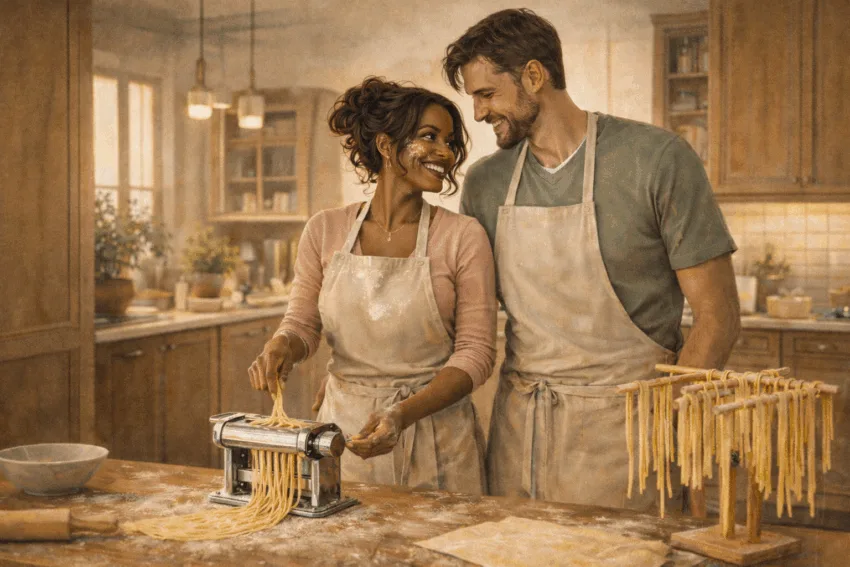
She tied the apron without looking, muscle memory doing the work. Pink cotton, fitted but forgiving. Sleeves pushed up. Hair in its familiar knot, the one that meant she was home enough to care less and focused enough to care more. There was flour on her cheek already, a soft smudge she hadn’t noticed—and wouldn’t have rushed to fix if she had.
He stood close, close enough to learn by watching rather than interrupting. Taller by nearly a foot, leaning in slightly, hands following where hers had just been. Sage green cotton stretched easily across his shoulders, sleeves short, uncomplicated. Practical. Intentional. The kind of clothes you wear when the goal isn’t presentation—it’s participation.
The pasta machine waited between them, clamped to the counter like it had always belonged there. She turned the handle slowly, explaining without overexplaining. How the dough should feel. When to stop. When not to rush it. A rack nearby held strands already drying, pale and imperfect and exactly right.
They laughed when the dough tore the first time. She dusted it with flour and kept going.
That was the thing—nothing here was precious. Not the clothes. Not the process. Not the moment. Everything had room to be used, touched, adjusted. Style, she believed, was never about keeping things pristine. It was about choosing things that could live alongside you.
She caught his wrist gently when he tried to take over too soon. Showed him again. Slower this time. Her shoulder brushed his arm. Familiar. Easy. The kind of closeness that didn’t need commentary.
From the outside, it might have looked like a scene worth romanticizing. Inside it felt simpler than that.
This was how she dressed when she planned to move freely.
This was how she lived when she wasn’t performing.
This was how intimacy showed up—side by side, hands in the same work, learning something together without needing an audience.
The pasta kept coming.
The light kept shifting.
And the kitchen held all of it—quietly, confidently—like it understood exactly what kind of day this was meant to be.
Kendra Trammel is a writer and brand steward examining personal style as a form of self-trust, expression, and lived identity.