This article contains spoilers. Continue at your own risk. Don’t @ me.
There is a moment in One Battle After Another when a mother tells a man that he is lost and therefore unsuitable for her daughter, a woman who comes from a lineage of strong, revolutionary Black women.
But the film never reconciles what it says with what it shows.
Because what unfolds on screen tells a different story entirely.
Sexual Power vs Sexual Compulsion
There is a critical distinction between sexual power and sexual spectacle, and the film collapses it almost immediately.
Sexual power is selective.
It is contextual.
It appears when it serves survival, strategy, or leverage.
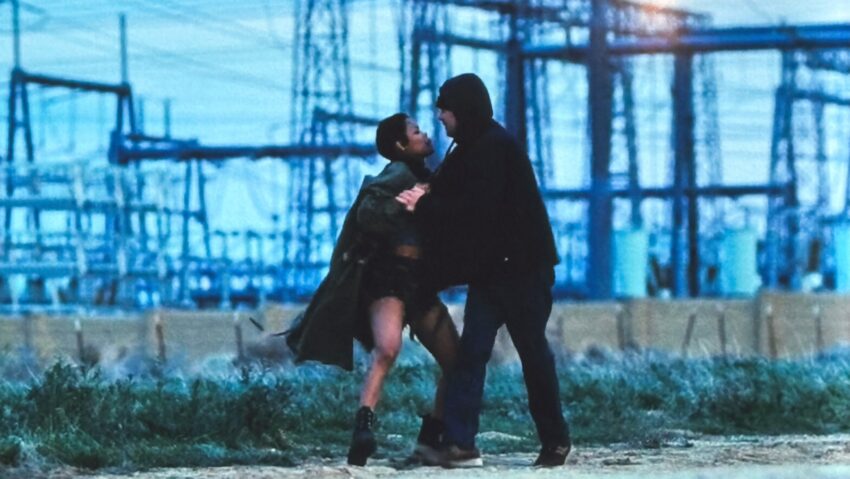
What the film presents instead, particularly in the first half, is something closer to sexual compulsion. Scene after scene positions the character played by Teyana Taylor in a state of constant sexual escalation, even in moments of extreme danger or urgency where such behavior defies psychological coherence.
At times, it reads less like agency and more like addiction. Not addiction in a clinical sense, but in a narrative one. Sexuality is no longer a tool. It becomes a reflex. It overrides survival logic, emotional attunement, and situational awareness.
That is not empowerment. That is flattening.
And the most telling detail is that the film itself seems to recognize this.
When the Sexuality Stops, the Character Emerges
After childbirth, the portrayal changes dramatically.
The hypersexual framing disappears. What replaces it is withdrawal, heaviness, emotional distance, and inwardness. Anyone familiar with accounts of postpartum depression will recognize the shift immediately.
This is not incidental.
It reveals that the film always had access to a more grounded, psychologically legible version of this character. When interiority is allowed, spectacle recedes. The character suddenly feels human rather than performative.
Which means the earlier portrayal was not necessary to communicate strength or danger. It was a stylistic choice.
“He isn’t lost, he’s standing at the edge of responsibility, trying to connect with someone who refuses to cross it with him.”
On the Claim of “Reflecting Real-World Fetishization”
In interviews, Taylor has defended her portrayal by saying the character reflects real-world fetishization and lack of protection experienced by Black women, and that the character strategically uses her sexuality as a weapon for survival and power.
This argument does not hold on screen.
Portraying fetishization is not the same as interrogating it. Reproducing a stereotype with confidence does not dismantle it.
If sexuality were truly being used as strategy, it would be rare, situational, and bounded by consequence. Instead, it is constant. It appears regardless of danger, context, or necessity.
That is not tactical deployment. That is narrative overuse.
A Necessary Caveat
There is a version of this story where sexual manipulation would make sense.
If a woman senses danger.
If she recognizes attraction in a captor.
If she performs interest to secure escape or safety.
That is survival. That is intelligence.
But that is not what the film depicts. The sexuality here does not read as a means to exit a situation. It reads as compulsion rather than calculation. Because of that, neither the actor nor the director can reasonably use that explanation as an out.
Lineage, Revolution, and the Cost of Myth
The film invokes revolutionary lineage repeatedly, as if lineage alone guarantees maturity.
But lineage is not inheritance unless behavior aligns with it.
Historically, revolutionary Black women demonstrated discipline, restraint, and clarity under pressure. Power rooted in intellect, ethics, and long-term thinking, not spectacle.
It is difficult to imagine many of those women endorsing a framework where sovereignty is proven primarily through sexual excess rather than intellectual authority or moral clarity.
Who the Film Calls Lost and Who Actually Is
The man the mother calls lost is the one who adapts, stays, fails openly, and ultimately becomes responsible for the child.
His manic energy earlier in the film is contextual. Acute stress, fear, drugs, and the terror of realizing his daughter has been taken while he is unprepared. That is not instability of character. That is a system overloaded by stakes.
Most importantly, he never stops trying to reconnect.
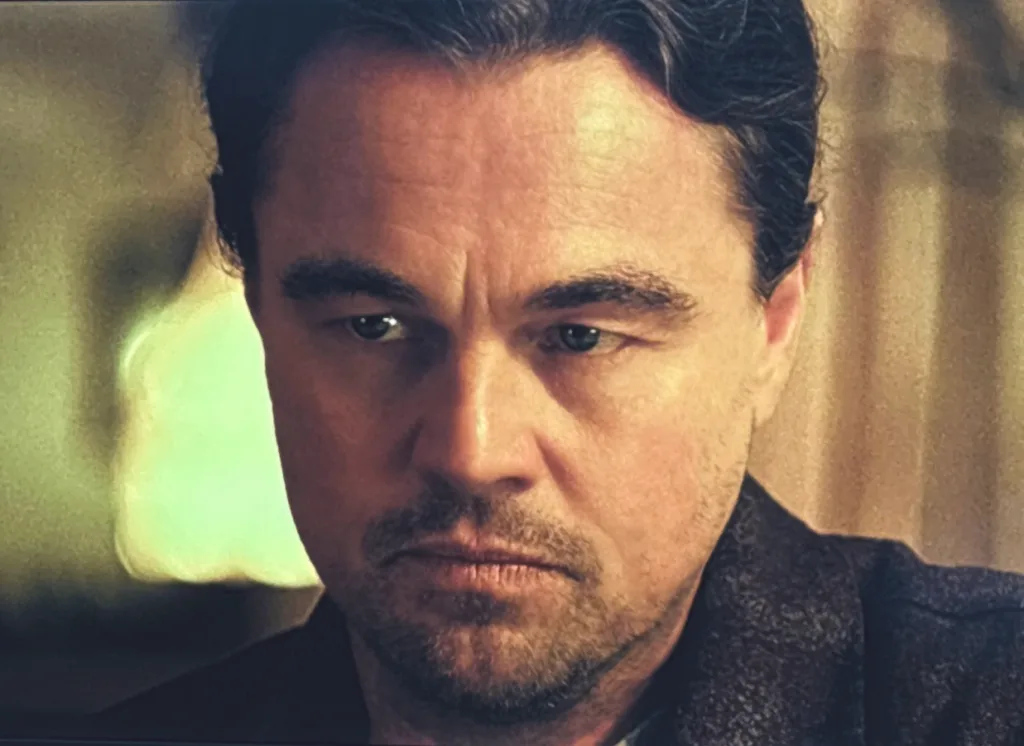
Which brings us to the line the film accidentally earns:
That is the truth the dialogue denies and the images confirm.
Reclaiming Power, Actually Shown
If the film wanted an example of a strong Black woman rooted in authority rather than performance, it already had one. That example arrives through the character played by Chase Infiniti, whose power is never announced and never explained.
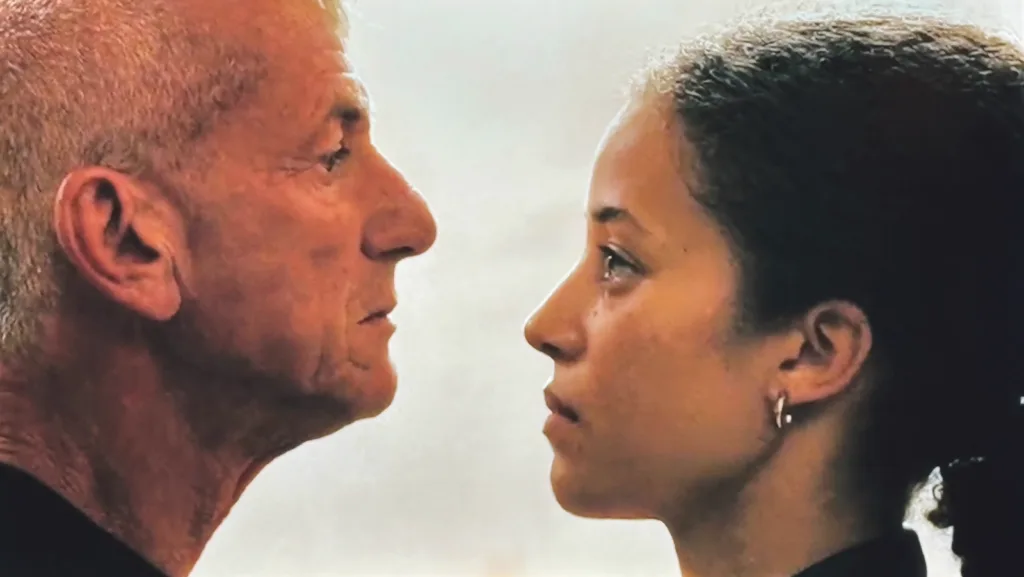
That authority crystallizes in a single exchange. When an armed guard steps away from a captured Willa, played by Infiniti, a man seated across the room tells her to come closer. She does not rush. She walks slowly, head lifted, shoulders back, posture intact. Her hands are still tethered. She is still under control. And yet she moves on her own terms.
She does not avert her eyes. She holds his gaze the entire time.
When she stops, she is nearly nose to nose with him. No sexual escalation. No provocation. No performance. Just presence. Even in fear, she does not shrink. Even without leverage, she does not offer herself up for interpretation.
This is what taking back power looks like.
And to be clear, when speaking on Taylor’s performance, this is not a criticism of sexuality itself. Sexuality is not the problem. Desire is not the problem. Erotic power is not the problem. What is being questioned here is the assumption that oversexualization equals strength, that constant sexual display is required to signal authority, or that excess automatically reads as liberation.
This is also not an argument against passion or forceful presence. Loud power can still be real power. What fails here is the insistence, particularly in post-release interviews, that repeated sexual escalation itself constitutes reclaimed control and empowerment as a Black woman.
Power does not need to be proved through constant performance. When it is real, it does not have to announce itself.
On Craft, Not Condemnation
None of this is an argument that Teyana Taylor is not a good actress. She is a very good one. Her physicality, fearlessness, and screen presence are undeniable.
But many of the most powerful actors working today do not rely on their bodies as primary instruments of meaning. They allow stillness, silence, and facial control to do the work.
That is a maturity of craft that often comes with time and restraint, not excess.
It is also unclear whether the choices in question were driven by the director, the actress, or a combination of both. That ambiguity matters. This critique is not about blame. It is about outcome.
What Real Strength Has Looked Like in My Life
Years ago, while living and working in Georgetown, I went on a date with an older attorney. Midway through dinner, he told me I was “so articulate.”
The implication was clear. Surprise that a Black woman could speak intelligently.
I did not perform. I did not become sexual. I did not attempt to reclaim power through display.
I named the comment as degrading. I thanked him for the part of the meal I had eaten. I stood up, gathered my things, hailed a cab, and went home.
That was the last time I saw him.
That is power.
Not spectacle.
Not explanation.
Not performance.
Withdrawal of access.
Final Thought
This is not an argument against sexuality.
It is an argument against substituting sexuality for intelligence.
It is not a rejection of radical women.
It is a call for radical maturity.
And it is not a dismissal of performance.
It is a demand that power be shown where it actually lives.
In restraint.
In accountability.
In the willingness to stay.
Kendra Trammel is a writer and brand steward engaging with art, performance, and cultural experiences that linger beyond the moment.